Shipyards: Heavy Maritime Construction
The construction of 150,000-gross-ton ocean vessels in dry dock resembles the assembly of horizontal skyscrapers, carried out by colossal gantry cranes that dwarf the surrounding coastline.
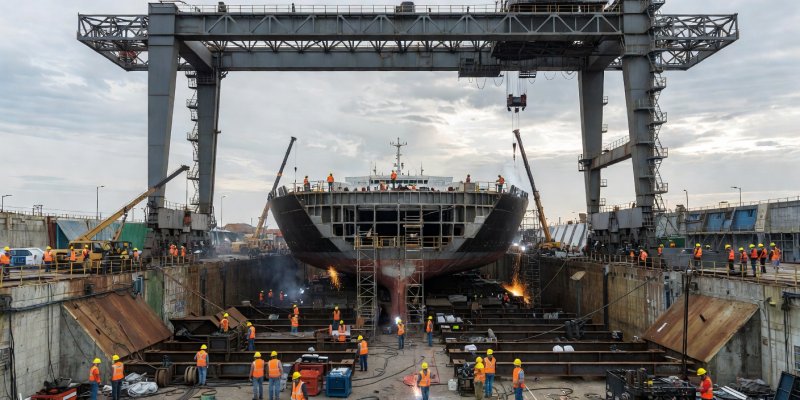
The Block Construction Method
Modern naval architecture no longer builds a ship keel-up plank by plank. Instead, shipbuilders utilize "mega-block prefabrication." Enormous modular sections—complete with pre-installed piping, electrical conduits, insulation, and even pre-assembled crew cabins—are welded together in indoor sub-assembly halls before being rolled out on hydraulic multi-wheel transporters.
For visitors standing along dry dock perimeters, the defining moment is witnessing the lift. A Goliath crane spanning over 100 meters across the dock picks up a 1,200-metric-ton steel block, rotates it in mid-air with millimetric precision, and lowers it into the flooded or drained basin to be welded into the ship’s growing skeleton.
Key Structural Nodes in Modern Yards
- Plate Cutting and Laser Welding Shops: Huge CNC plasma arc and fiber-laser cutters slice through structural steel plates up to 50mm thick with surgical accuracy. Automated panel lines then butt-weld plates into continuous stiffened skin panels.
- Dry Dock Keel Blocks: The floor of a dry dock is lined with massive reinforced concrete and hardwood keel blocks. Calculating the load distribution for a vessel weighing tens of thousands of tons when the basin pumps empty millions of gallons of seawater is an extraordinary civil engineering feat.
- Outfitting Quays: Once launched from the dry dock, ships are moored alongside dedicated fitting quays where engine testing, electronic mast outfitting, and interior finishing occur before open-sea trials.
Notable Operating Shipyards with Visitor Access
Meyer Werft (Papenburg, Germany)
Located on the River Ems, Meyer Werft is one of the world’s most modern shipyards, specializing in luxury cruise ships. Because harsh North Sea winter weather disrupts outdoor work, Meyer Werft constructed the largest covered dry docks in the world. Its Covered Building Dock II measures an astonishing 504 meters in length, 125 meters in width, and 75 meters in height. Visitors view vessels under construction through elevated panoramic glass balconies with direct audio feeds explaining ongoing welding operations.
Chantiers de l'Atlantique (Saint-Nazaire, France)
Covering over 150 hectares at the mouth of the Loire estuary, Saint-Nazaire has produced historic ocean liners like the SS Normandie, Queen Mary 2, and the largest modern Oasis-class vessels. Guided bus and walking technical tours bring observers to the edge of the 900-meter "Forme Joubert" lock and beneath the 1,400-ton capacity gantry crane.
| Shipyard Facility | Location | Primary Production | Notable Crane Asset | Visitor Experience |
|---|---|---|---|---|
| Meyer Werft | Papenburg, Germany | Mega-Cruise Vessels | Twin 800-ton Indoor Gantry | Enclosed visitor center with glass balconies |
| Chantiers de l'Atlantique | Saint-Nazaire, France | Cruisers & Naval Tankers | 1,400-ton Goliath Crane | Guided perimeter industrial coach tour |
| Hietalahti Shipyard | Helsinki, Finland | Arctic Icebreakers | Covered Basin Cranes | Specialized maritime engineering tours |
| Navantia Shipyard | Ferrol & Cartagena, Spain | Frigates & Submarines | Coastal Gantry & Syncrolift | Technical group tours arranged via naval office |
Navigating Safety at Active Shipyards
Heavy shipyard environments carry significant movement hazards: 60-axle SPMTs (Self-Propelled Modular Transporters) navigate narrow corridors, while high-velocity grit-blasting and spray painting run continuously in neighboring bays. Civilian visitors are kept strictly on elevated walkways or inside dedicated inspection vehicles to eliminate risks of falling objects or traffic conflicts.