Automotive: Assembly Robotics
Suspended above the production grid on vibration-damped steel catwalks, visitors watch a synchrony of hundreds of multi-axis robotic arms executing thousands of resistance spot welds in clouds of gold spatter.
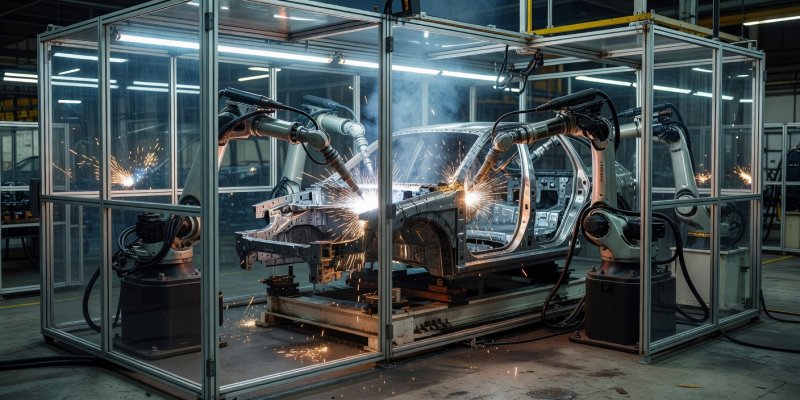
The Geometry of Modern Body Shops
Automobile production facilities represent some of the most capital-dense real estate on Earth. For the industrial traveler, the experience divides cleanly into three operational areas: the stamping plant, the body-in-white (BIW) robotic cell, and the final assembly line featuring the "marriage point."
In the stamping hall, mechanical transfer presses stamping cold-rolled sheet steel deliver impacts with up to 10,000 metric tons of force. The rhythmic thud displaces air through the factory hall, producing a distinct physical shockwave in the chest. From there, unpainted side-frames, floors, and roofs enter the body shop, where human labor is virtually absent.
Key Mechanical Sequences to Observe
- Framing Stations: This is where the car body becomes rigid. Massive geometric framing fixtures clamp roof rails and door pillars into alignment while up to 18 six-axis robots (KUKA, ABB, or Fanuc) strike simultaneously, securing structural integrity in under 45 seconds.
- Structural Adhesive Application: High-precision dispensing nozzles apply continuous micro-beads of aerospace-grade epoxy to seal structural joints, replacing traditional welds to enhance chassis torsional rigidity.
- The Marriage Station ("Hochzeit"): On the final assembly conveyor, the painted vehicle monocoque descending from an overhead cradle meets the rolling chassis (containing battery pack or engine, driveline, and suspension) ascending from an automated guided vehicle (AGV). Multiple automatic spindle drivers torque twenty or more chassis bolts simultaneously in less than 20 seconds.
Prime European and American Facilities with Public Access
BMW Werk Leipzig (Leipzig, Germany)
Designed by Pritzker Architecture Prize laureate Zaha Hadid, the Leipzig plant is famous because the physical car bodies move silently along illuminated overhead conveyors directly through the central administration and canteen spaces. White-collar engineers and visiting tour groups see half-finished vehicles float overhead while walking to conference decks.
Ford Rouge Complex (Dearborn, Michigan, USA)
The spiritual birthplace of mass vertical manufacturing, the modern Dearborn Truck Plant assembles the aluminum-bodied F-150. A quarter-mile elevated mezzanine walkway gives visitors panoramic observation access over the final assembly line, demonstrating just-in-sequence logistics where parts bins arrive precisely timed via robotic AGVs.
| Assembly Plant | Key Vehicle Lines | Automation Level | Walkway Clearance | Photography Rule |
|---|---|---|---|---|
| BMW Werk Leipzig | 1 Series, 2 Series, MINI Countryman | 99% in Body Shop | Catwalk directly over weld cells | Strictly prohibited (Lockers provided) |
| Ford Rouge Factory | F-150 Lightning & Gas | High in Body / Mixed Assembly | Enclosed mezzanine observation | Allowed only in exterior observation deck |
| Volkswagen Gläserne Manufaktur | ID.3 Electric Platform | Precision Human Assembly | Polished parquet floor level tour | Permitted in visitor center areas |
| Porsche Werk Zuffenhausen | 911, 718, Taycan | Advanced AGV Floor-Guided Flow | Guided shop-floor escort paths | Strictly prohibited; lens seals applied |
Optical Safety and Noise Mitigation
Because automated body shops utilize thousands of open electrical resistance spot welds per minute, specialized tinted safety glasses or acoustic glare screens are installed along public bridges. These protect against ultraviolet flash and stray molten sparks. Acoustic baffles dampen the piercing pneumatic hiss of robot clamps to manageable safe exposure levels.
Factory Visitor Protocol Notice
Automotive plants require closed-toe footwear with flat rubber soles. Sandals, high heels, and soft fabric trainers are banned at reception. Cellphones, smartwatches with cameras, and recording devices must be surrendered at the entrance turnstiles to protect proprietary assembly patents and pre-production prototypes.